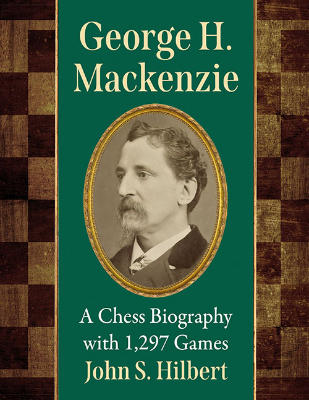
According to his biographer John S. Hilbert, George H. Mackenzie was universally loved during his lifetime but utterly forgotten after his death. George H. Mackenzie: A Chess Biography with 1,297 Games presents Mackenzie’s games and stories about his life and times.
Old Masters
When Governor Bob Ferguson, a chess master, welcomed participants in the US Chess Federation’s National K-12 Grade Championships to Washington State, he advised them to “study Rubinstein’s endgames” and to “learn a lot from going over Capablanca’s games.” Lasker and Morphy also got shout outs. Ferguson concluded, “Those old masters, from a long, long time ago…may not seem so relevant….[But] if you play through their games…your game will improve.”
Ferguson didn’t mention George H. Mackenzie. But Mackenzie fits with the other names on the governor’s list, particularly with Paul Morphy. Mackenzie and Morphy were born in 1837. Both were known for decisive attacks and sacrificing material. And each man lived in the United States, though Mackenzie was Scottish by birth.
George H. Mackenzie: A Chess Biography with 1,297 Games makes the comparison explicit as early as page 2:
Mackenzie during his lifetime was called a chess romantic in the tradition of Morphy. Indeed, he called himself “a small Morphy” (playing humorously on his build, six feet tall and with a military bearing, in contrast to the diminutive Creole). The biography proper includes over 1,000 of his games, while Appendix A provides 260+ more. They represent fighting chess, with dozens and dozens of Mackenzie’s “gems,” as he called them, scattered throughout.
Gems
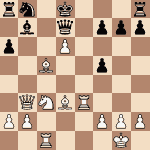
An endnote explains that gems are brilliant games. Presented as game #192 in Hilbert’s book, this gem has a smothered mate theme.
Macy’s and Mackenzie
Macy’s and Mackenzie began their existence in the United States within five years of each other. Macy’s opened in 1858, at the corner of 14th Street and 5th Avenue, in Manhattan. Hilbert wrote, “the earliest reference to Mackenzie in the United States appeared in mid–August 1863,” when he played games at the Brooklyn Chess Club.
Macy’s first location was modest, but just after the turn of the century it moved to its flagship location on Herald Square.
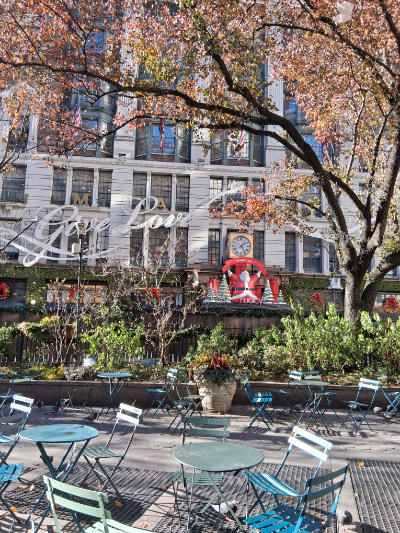
Mackenzie did not live to see the new century, dying in 1891 in the Cooper Union Hotel, a boarding house with shady clientele. He had lived there for the past 17 years, as playing chess did not pay well.
On an early December visit to New York City, I spotted chess-themed merchandise at Macy’s. Its creator was MacKenzie-Childs.
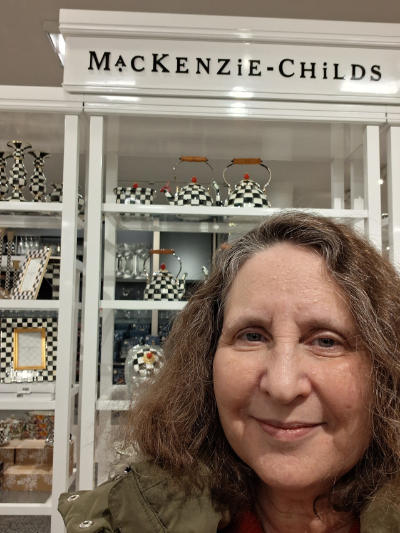
Mackenzie often played chess for 25 cents a game. Even accounting for inflation, it would have taken him weeks to earn enough to buy items like those produced by MacKenzie-Childs. But he might not have wanted such knick-knacks and home furnishings, as he traveled a lot.
When Mackenzie wasn’t at the Cooper Union Hotel and frequenting New York City chess clubs, he was giving exhibitions and playing matches all over the United States and Cuba. Occasionally he competed in top-level tournaments in Europe. At his peak, he was one of the top 10 chess players in the world. Thanks to Hilbert chronicling his life and games, Mackenzie may be remembered as one of the old masters.