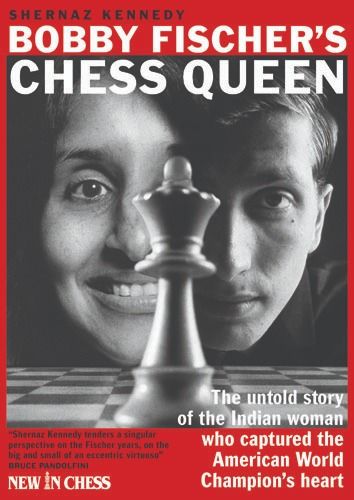
On January 14, 2026, New In Chess published Bobby Fischer’s Chess Queen: The untold story of the Indian woman who captured the American World Champion’s heart. Its author is Woman International Master Shernaz Kennedy. Her memoir is a quick and entertaining read but has factual errors.
Privileged Childhood
Before she moved to the United States and married John Kennedy (a chess player) in October of 1980, Shernaz’s last name was Mistry. Her father, Minoo, was a pilot. Her mother stayed home with Shernaz and her three brothers. The family joined the Otters Club when it opened in 1973. There Shernaz enjoyed swimming, table tennis, and squash. She played badminton at Bandra Gym.
When the family spent three years in London, due to her father being assigned to fly the London to New York route for Air India, she added dancing to her sporting activities. And she was first board for her school’s chess team, ahead of boys. Before the Fischer–Spassky World Chess Championship match, she sent Fischer three letters. Later, she found out that he brought the letters to that 1972 match in Iceland.
Chess Training
After the untimely death of her teenage sweetheart, whom she had met at Bandra Gym, Shernaz decided to move to the United States in 1977. She hoped to train at chess with Fischer, and they exchanged multiple letters and frequent phone calls. She didn’t meet him in person until 1986.
Before meeting Fischer, Shernaz was befriended by a pre-teen Max Dlugy, who later became a grandmaster. He taught her how to ride the subway, and he introduced her to Jack Collins. From lessons with Collins and with IM Vitaly Zaltsman, her rating rose from 1815 to 2186. She wrote that the latter rating was unofficial—from the mailing label on her Chess Life & Review—and made her the second highest rated woman in the United States.
Fact Check: U.S. Women’s Championships
While I don’t know if Shernaz accurately represented her life in India, her chess training, or her relationship with Fischer, I do know that either Shernaz or her publisher made multiple errors regarding her participation in U.S. Women’s Championships.
New In Chess’s author bio states that Shernaz competed in “ten U.S. Women’s championships.” But she played in only five: 1981, 1984, 1986, 1989, and 1990.
She wrote, “In 1987 I traveled to South Carolina to play in the Women’s Invitationals.” But in 1987 the U.S. Women’s Championship was in Colorado and Shernaz was not among its participants. Continuing the error, she wrote about 1987, “I knew I should be able to finish in second place, behind Elena Akhmilovskaya, a leading Women’s World Champion contender.” But Akhmilovskaya didn’t play her first U.S. Women’s Championship until 1990.
Shernaz mentioned defeating Natasha Us and Vesna Demetrovich [sic; Dimitrijevic], neither of whom played in the U.S. Women’s Championship in 1987. But they played in 1989, the year that I won. Probably she confused 1987 with 1989, and me with Akhmilovskaya.
Shernaz stated that she got her “International Women’s Master” title in 1987. But her Woman International Master title came in 1989, as a result of her score in that year’s U.S. Women’s Championship (which was a zonal).
Memoirs
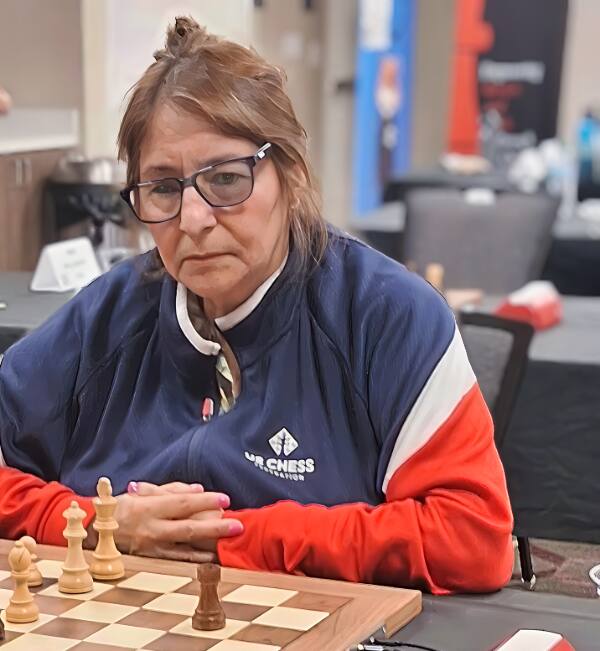
In an interview with documentary filmmaker Adam Whitaker, Shernaz said, at one hour and 24 minutes in, “Because this is a memoir, every line had to be fact check.” Her fact checking failed, at least regarding the U.S. Women’s Championships. And Shernaz had a copy of United States Women’s Chess Champions, 1937–2020. She bought it from me when she and I participated in the 2023 U.S. Senior Women’s Championship. Had she consulted my book, some of the errors in her book could have been avoided.
When memoirs have errors, who is to blame? According to one publishing industry insider interviewed about memoirs, the author rather than the book publisher is responsible. Books are “individual statements or inventions by particular authors.” And, on the practical side, publishers can’t afford fact checkers.
From that same insider, “more and more of what we’re reading comes under the guise of memoir and memoir is a very tricky form.” Shernaz Kennedy managed many of its tricks. Her memoir’s storyline has an engaging arc, from young Shernaz wanting Fischer’s help to mature Shernaz helping him negotiate chess conditions. John Kennedy and their four children are clearly drawn characters. She convincingly sketched Bandra, India, and New York City. No chess games, though some references to openings (especially to the Sicilian Defense). I enjoyed her memoir, even though my role in it was played by Elena Akhmilovskaya.

Shenanz was Totally Obsessed with Chess. I played with her first in 1976 at Mumbai & became her friend, I moved to Mumbai, and lived in Bandra, and was barely 300 meters away from residence of Shernaz. There was only One chess Club at Mumbai, at Zandu Canteen, at Parel. I used to go regularly to the same chess club & and returned to Bandra along with Shernaz. In fact , this changed my life & Chess career.
Eventually Shernaz Married to Jon Kennedy and settled at New York. But when she came a visit to Mumbai, in 1984, called me. when I met her, she asked me to come to USA , for better chess prospects. I was extremely happy. In fact, my Chess career changes to a big leap. I became an International Master at USA , which was a remote Dream , for any Indian Chess player at that time. Shernaz used to tell me about her conversation , with Bobby Fisher.
I remain Highly Obliged to Shernaz Kennedy for all her help. , and remain beheld to her, for life !! Long Live Shernaz , A chess Phenomena !!!