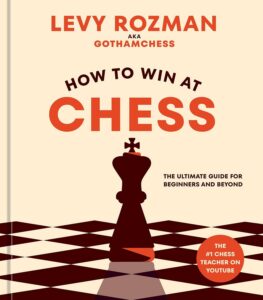
In 2023, Ten Speed Press (part of Penguin Random House) published How to Win at Chess: The Ultimate Guide for Beginners and Beyond by International Master and YouTube’s top chess teacher Levy Rozman (aka GothamChess).
On October 6, 2026, when the book’s sequel was published, the GothamChess channel had 8.35 million subscribers. This SparkChess article is about Rozman’s first book. My next article will be about its sequel, How to Win at Chess, Next Level: The Ultimate Guide for Intermediate Play.
Categorizing Openings
Even experienced players, like me, can benefit from Rozman’s first book. For example, I acquired three terms—“Traditional Openings,” “Setup-Based Openings,” and “Building-Block Openings”—for grouping familiar openings.
Traditional Openings often begin with Black mirroring White, such as 1.e4 e5 or 1.d4 d5. More broadly, Rozman describes such openings as “making the most logical responses to White’s moves in the opening” (page 42).
Setup-Based Openings, such as the Pirc/King’s Indian Defense, use almost the same initial moves in every position. The order may vary, but includes 1…g6, 2…Bg7, 3…d6, 4…Nf6, 5…0-0. The Dutch Defense is another Setup-Based Opening.
Building-Block Openings, such as Rozman’s favorite Caro-Kann Defense, have a first move that supports a pawn in the center (1…c6). The second move builds on the first (2…d5). Another Building-Block Opening is the French Defense (1…e6 followed by 2…d5). In contrast to Setup-Based Openings, which can be played against most of White’s first moves, Building-Block Openings work only against specific moves. The Caro-Kann and French Defenses are played against 1.e4 but not against 1.d4.
Also eye-opening was Rozman’s advice, when playing Black, about what to anticipate from White. On page 142, he wrote, “e4 is 2.5 times as popular as d4, and combined e4 and d4 openings will constitute 90–95 percent of the games you’re going to play.”
Book versus YouTube Videos
Which is better: Reading Rozman’s first book or watching his YouTube videos? Reading is faster than watching, even factoring in the extra time needed to scan the book’s QR codes and click through its supplementary online material. But his YouTube videos may offer better content. Let’s look at one example, comparing three pages from Rozman’s first book with just over eight minutes from one of his YouTube videos.
Queen versus Pawn
On December 14, 2020, when the GothamChess channel had 275,000 subscribers, Rozman taught queen versus pawn. Within the first 7-and-a-half minutes of this YouTube video, he taught how the side with the queen wins when the opposing pawn, one square from promoting, is a b-, d-, e-, or g-pawn.
This is an important win to know! As I discussed in a previous SparkChess article, “With 15 seconds left on his clock, in a G/10 blitz game, Jacob Fortuna did not execute the winning pattern in queen versus pawn on the seventh rank.” His queen was on f4, and his king was on g6, with White (Fortuna) to move. Black had an e2-pawn and a king on g2. Because Fortuna hadn’t mastered this endgame, he turned a win into a draw.
Rozman’s YouTube video next taught how to draw, using stalemating tricks, for the side with an a-, c-, f-, or h-pawn one square from promotion and supported by its king. Those patterns took about 45 seconds to show.
The a- and h-pawns are “rook pawns” meaning they are on files where rooks began the game. The YouTube screenshot shows why a queen versus a rook pawn is usually a draw. The king hides on the promotion square for the rook pawn and stalemates itself.
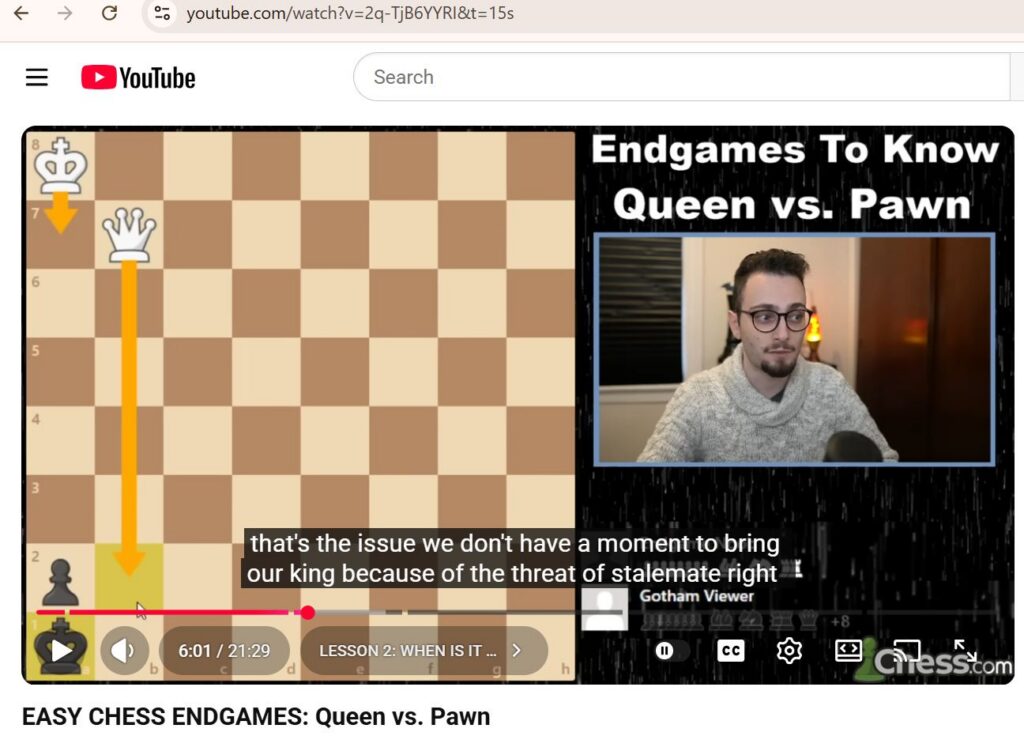
To maximize drawing chances against a queen with a bishop pawn, meaning that it is on a file where a bishop began the game, put the king in the corner. If the queen captures the bishop pawn, the resulting position is stalemate.
On pages 186–189 of How to Win at Chess: The Ultimate Guide for Beginners and Beyond, Rozman taught the same endgame. Page 186 has a mistake in it, which I have highlighted in yellow.
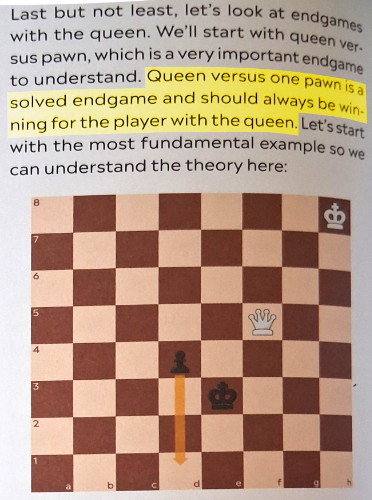
If you have read this far, you know why that highlighted statement, about the side with the queen always winning, is wrong. If Black has a rook or a bishop pawn, about to promote and supported by its king, Black usually draws.
Rozman shows those drawing patterns on page 189, correcting what he wrote three pages earlier. Besides being more accurate, the YouTube video teaches additional subtleties about queen versus pawn. After the first 8 minutes and 15 seconds, it shows how the stalemating tricks may fail if the side with the queen has its king close to the pawn. That information does not appear in the printed pages of Rozman’s first book or in its supplementary material.
Buy the Book!
Rozman’s first book has a handful of other inaccurate statements. As with the one illustrated in the section above, he usually corrects his mistakes within a few pages. The book’s errors are outweighed by well-organized content that beginners must learn. The diagrams are plentiful, clear, and helpful. The table of contents and the index add to the organizational structure.
I agree with Amazon’s description of How to Win at Chess: The Ultimate Guide for Beginners and Beyond: “[a] refreshing and fun guide for beginner and intermediate players. Clever and informative, How to Win at Chess teaches you everything you need to know about the game, including all the important moves and strategies to start off strong and keep you thinking several steps ahead.”