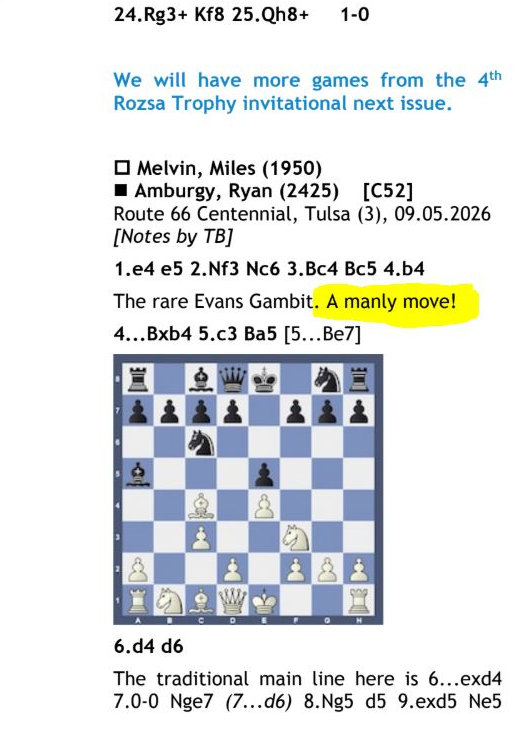
In the June 2026 issue of Oklahoma Chess Magazine, editor Tom Braunlich annotated a game between Miles Melvin and FM Ryan Amburgy. About White’s fourth move, b4, National Master Braunlich wrote, “The rare Evans Gambit. A manly move!”
Almost 50 years earlier, National Master Guthrie McClain wrote that then Women’s World Champion Maia Chiburdanidze played like a man.
You’re Not Doin’ Fine, Oklahoma
Perhaps the most famous lyrics about Oklahoma are “You’re doin’ fine, Oklahoma! Oklahoma, O.K.!” After reading Braunlich’s annotation, I felt that Oklahoma was not doing fine. The Oklahoma Chess Magazine serves as the official publication of the Oklahoma Chess Association. In my opinion, it should avoid sexist language. It’s not O.K.
I asked Braunlich, as the magazine’s editor, to substitute a different adjective for “manly.” I wrote that women play the Evans Gambit too. He replied to my June 1 email within hours but did not change the adjective. The PDF of the June issue still had, as of June 2, “A manly move!” on page 16. See the image below, with my highlighting in yellow.
A Woman Who Plays Like a Man
Almost 50 years before Braunlich characterized a chess move as manly, Guthrie McClain wrote “A Woman Who Plays Like a Man” for the June/September 1979 issue of the Northern California Chess Association’s Chess Voice. In 1979, McClain was only three years retired from serving as the editor of The California Chess Reporter (the official chess magazine of the California State Chess Federation).
Quoting my own chapter on WIM Rachel Crotto from United States Women’s Chess Champions, 1937–2020, here is what McClain wrote about Chiburdanidze’s win over WGM Alla Kushnir.
Her startling positional Queen sacrifice in the fifth game reveals her style to be quite different from her opponent’s. In a word – she plays like a man.
I must explain myself before the Women’s Libbers come down on me like a ton of bricks. Most women do not look for a fight. This is not cowardly, but rather a self-control that many men do not have, being subject as they are to flows of adrenalin and surges of emotion – the sort that prompted cave men [sic] to go out and take on tigers and bears. I have observed this self-control and caution in woman [sic] chess players for fifty years.
At the time of McClain’s article, Chiburdanidze was a WGM. She became a GM in 1984.
Rachel Crotto Challenged Anachronistic Views
Crotto replied to McClain’s article with multiple games by women chess players. Chess Voice published two of the games and her article. The latter directly challenged McClain’s “anachronistic views.” Women’s chess games, she wrote, “demonstrate the amazing range of styles among female chess players. (Coincidentally, the same range exists among male players.)”
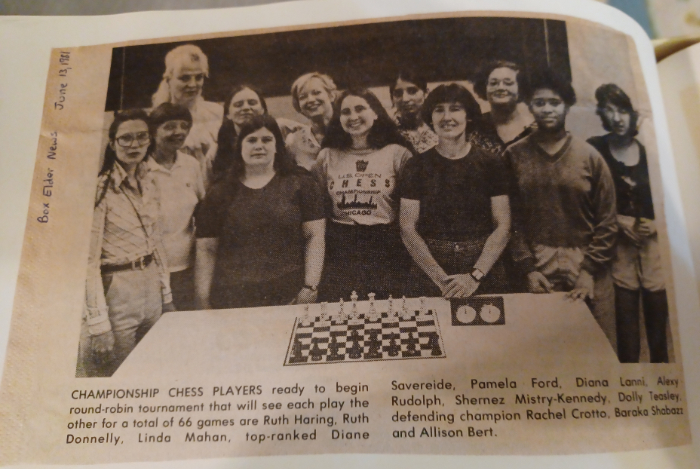
The first time I met Crotto was at the 1981 U.S. Women’s Championship, back when my last name was Rudolph. At the time, she was the reigning U.S. Women’s Champion. In the photo from the Box Elder Journal below, the caption has some typos. Correct is Alexey (not Alexy), Shernaz (not Shernez), and Alison (not Allison). The names are left to right but include the back row as part of the left to right.
Evans Gambit
In memory of Crotto, who died in 2025, let’s look at an Evans Gambit from the FIDE Women’s Candidates Tournament 2024.
In Lei Tingjie versus Aleksandra Goryachkina, White plays 4. b4 not like a man but like a grandmaster. Because she and her opponent are grandmasters!

Wow just wow, complaining about 2 instance that happened decades ago. Get a life
I’d separate the cases quite sharply:
“Chiburdanidze plays like a man because women normally aren’t combative” is plainly sexist reasoning.
“4.b4! A manly move!” is gendered and somewhat old-fashioned language, certainly. Necessarily sexist, no. In the context of an Evans Gambit annotation, the perfectly ordinary interpretation “bold, swashbuckling, gutsy move” is strong.
Root’s broader historical point, that chess language has sometimes treated aggression and excellence as masculine, is well supported. Her decision to use Braunlich’s harmless-looking one-liner as the modern equivalent of McClain’s explicit theory about female psychology is the least convincing part of the article.